
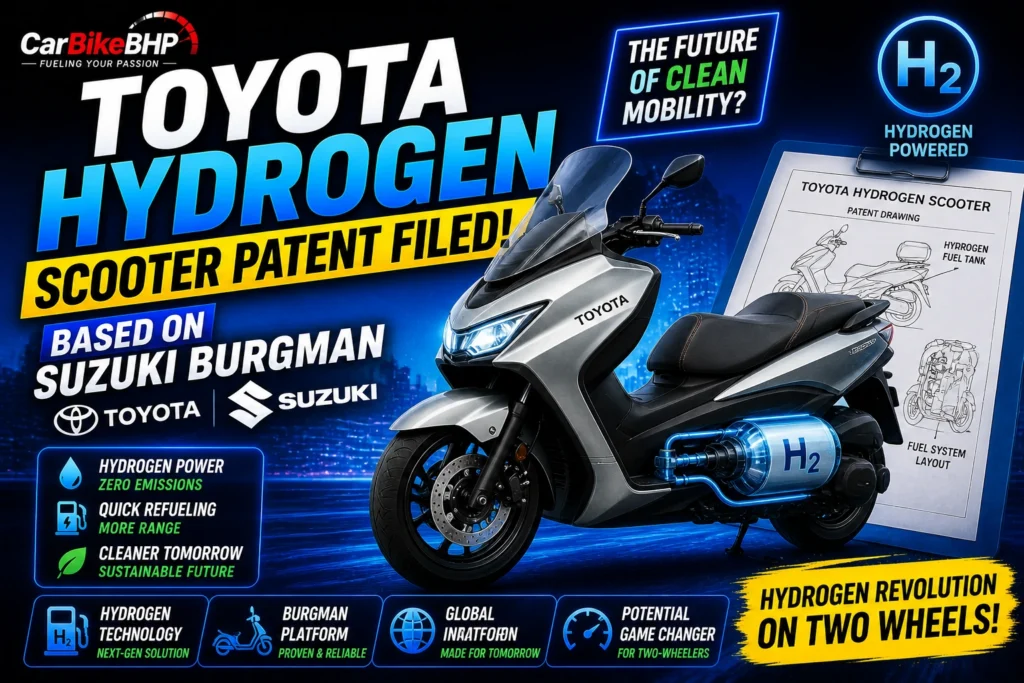
The Toyota Hydrogen Scooter concept has taken a major step forward with a new patent filing, revealing a hydrogen-powered scooter based on the Suzuki Burgman platform. This patent highlights how Toyota is exploring hydrogen technology beyond cars and into two-wheelers.
For India, where scooters dominate daily commuting in cities like Delhi, Pune, and Bangalore, this development is particularly interesting.
Based on Suzuki Burgman – What It Means
The Toyota Hydrogen Scooter appears to be built on the Suzuki Burgman platform, which is already a well-known premium scooter in India.
Why Burgman Platform Matters:
- Proven design and comfort
- Maxi-scooter styling with good road presence
- Suitable for urban commuting
By using an existing platform, Toyota can focus more on developing the hydrogen powertrain rather than redesigning the entire scooter.
Design Insights from Toyota Hydrogen Scooter Patent
The patent images of the Toyota Hydrogen Scooter reveal some key changes compared to a regular Burgman.
Key Observations:
- Hydrogen fuel tank integrated within body
- Modified under-seat storage area
- Additional components for fuel system
- Retained overall Burgman styling
This suggests Toyota is trying to balance practicality with new technology, which is critical for real-world usability.
How Hydrogen Technology Works in Scooters
Unlike electric scooters, the Toyota Hydrogen Scooter would use hydrogen fuel instead of a battery.
Basic Working:
- Hydrogen is stored in a tank
- It is converted into energy via combustion or fuel cell
- Energy powers the scooter
Key Advantages:
- Faster refuelling compared to EV charging
- Potentially longer range
- Lower emissions (water vapor in fuel cell systems)
However, the technology is still in early stages for two-wheelers.
Performance and Practicality Expectations
While exact specs are not revealed, the Toyota Hydrogen Scooter is expected to focus on practicality rather than performance.
Expected Characteristics:
- Similar performance to petrol scooters
- Smooth and quiet operation
- Adequate range for city commuting
For Indian conditions—daily office commutes, short trips, and heavy traffic—this setup could work well if infrastructure supports it.
Toyota Hydrogen Scooter India Launch Possibility
As of now, there is no official confirmation regarding the India launch of the Toyota Hydrogen Scooter.
However, there are key challenges:
Major Limitations:
- Lack of hydrogen refuelling infrastructure
- High cost of technology
- Limited real-world testing
In India, EVs are already gaining momentum, so hydrogen scooters may take longer to become viable.
Also read – All-New 2026 Suzuki Burgman Street (2nd Gen) Launched at ₹1,01,944 – Bigger Update Than Before
Expected Price of Toyota Hydrogen Scooter
Pricing is purely speculative at this stage, but hydrogen technology is currently expensive.
Expected Range (If Launched):
- Likely higher than premium petrol scooters
- Could be priced above ₹1.5 lakh (ex-showroom) initially
This would make it a niche product rather than a mass-market scooter.
Rivals and Alternative Technologies
The Toyota Hydrogen Scooter will not have direct rivals immediately, but it competes indirectly with:
Comparison:
Electric Scooters
- Already available
- Growing charging infrastructure
- Lower running cost
Hydrogen Scooter
- Faster refuelling
- Potentially longer range
- Currently lacks infrastructure
What It Means for Indian Buyers
For Indian buyers, the Toyota Hydrogen Scooter is more of a future technology preview rather than an immediate buying option.
Key Takeaways:
- Hydrogen could be an alternative to EVs in the future
- Infrastructure will decide its success
- EVs remain the practical choice today
In cities like Bangalore or Hyderabad, where charging stations are increasing, EVs still make more sense currently.
Future of Hydrogen Two-Wheelers in India
The Toyota Hydrogen Scooter shows that manufacturers are exploring multiple paths for sustainable mobility.
Possible Future Developments:
- Expansion of hydrogen infrastructure
- Cost reduction with scale
- Hybrid hydrogen-electric solutions
However, this will take time, especially in a price-sensitive market like India.
Verdict
The Toyota Hydrogen Scooter patent is an exciting glimpse into the future of mobility. By using the Burgman platform, Toyota is taking a practical approach to introducing new technology.
However, for India, this remains a long-term possibility rather than an immediate reality. With EV adoption already accelerating, hydrogen scooters will need strong infrastructure and cost advantages to compete.
For now, the Toyota Hydrogen Scooter is a concept worth watching—but not something Indian buyers will see on roads anytime soon.