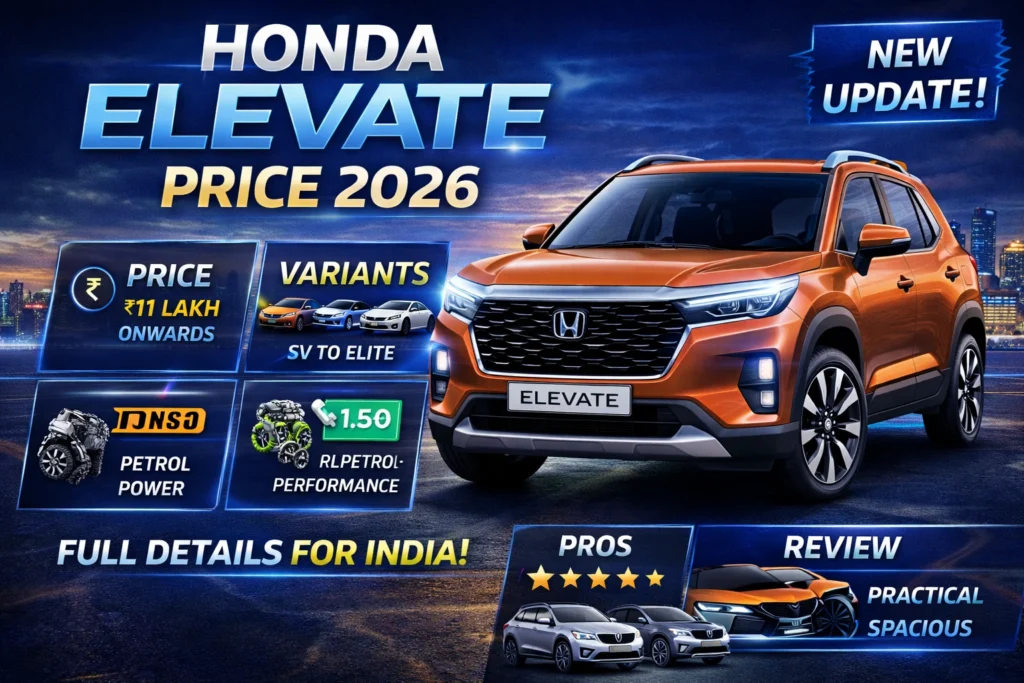
What Is the Honda Elevate?
The Honda Elevate is the Japanese carmaker’s first proper mid-size SUV built specifically for India — not adapted from a global model, but engineered from scratch in India, for Indian roads, Indian families, and Indian ownership expectations. Launched in 2023 and updated for 2025–2026 with the new ADV Edition, Black Edition, and fresh interior colours, the Elevate competes directly in one of the most ferociously contested segments in the country: the ₹11–18 lakh compact SUV space where the Hyundai Creta, Kia Seltos, Maruti Grand Vitara, Tata Nexon, and Skoda Kushaq are all fighting for the same buyer.
Honda’s pitch with the Elevate is deliberately un-flashy: no turbo engine, no strong hybrid, no segment-first feature gimmicks. Instead it leads with things Honda has always been trusted for — a bullet-proof 1.5L naturally aspirated engine, a refined CVT gearbox, segment-best 220mm ground clearance, segment-best 458-litre boot, and the lowest 5-year service cost in the category.
The question that matters for an Indian buyer spending ₹13–20 lakh on-road is this: is Honda’s “boring but bulletproof” approach worth the premium over a feature-loaded Korean rival? After reading every owner review, every long-term report, and 3 years of real-world data since its launch, we can give you a straight answer.
Honda Elevate Price in India 2026 — Complete Variant-wise List
The Honda Elevate price starts at ₹11.60 lakh for the base SV variant and goes up to ₹16.25 lakh for the ZX CVT, with the new ADV Edition CVT Dual Tone topping out at ₹16.77 lakh — all ex-showroom India. V3Cars The interactive table above has every variant, on-road price across 7 cities, and EMI estimates. Here’s what to know before you start variant-hunting:
The SV is an airport variant. At ₹11.60 lakh it comes with only a 7-inch touchscreen, manual AC, 4 airbags, and no sunroof. It exists to create a headline starting price. Most serious buyers should start from V upwards.
The V CVT at ₹13.22 lakh is the sweet spot for automatic seekers. You get the 10.25-inch touchscreen, sunroof, auto climate control, and wireless connectivity — the features that matter on a daily commute — without paying for ADAS you may rarely use.
The VX CVT at ₹14.91 lakh is the recommended buy. This is where the Elevate makes its strongest case. You get all of the above plus 6 airbags, Honda Sensing ADAS (collision mitigation, lane departure, adaptive cruise), Lane Watch camera, and wireless charging. At this price you are getting more safety hardware than any rival offers at the equivalent trim. The gap between VX CVT and ZX CVT is ₹1.34 lakh — that buys you 8-speaker audio and Honda Connect. Decide if that’s worth it for your use case.
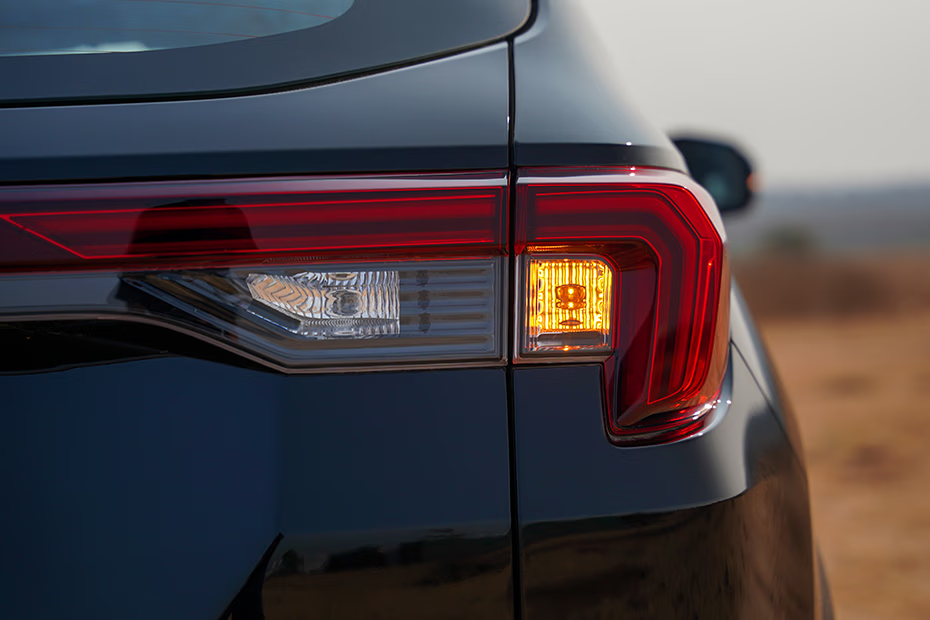
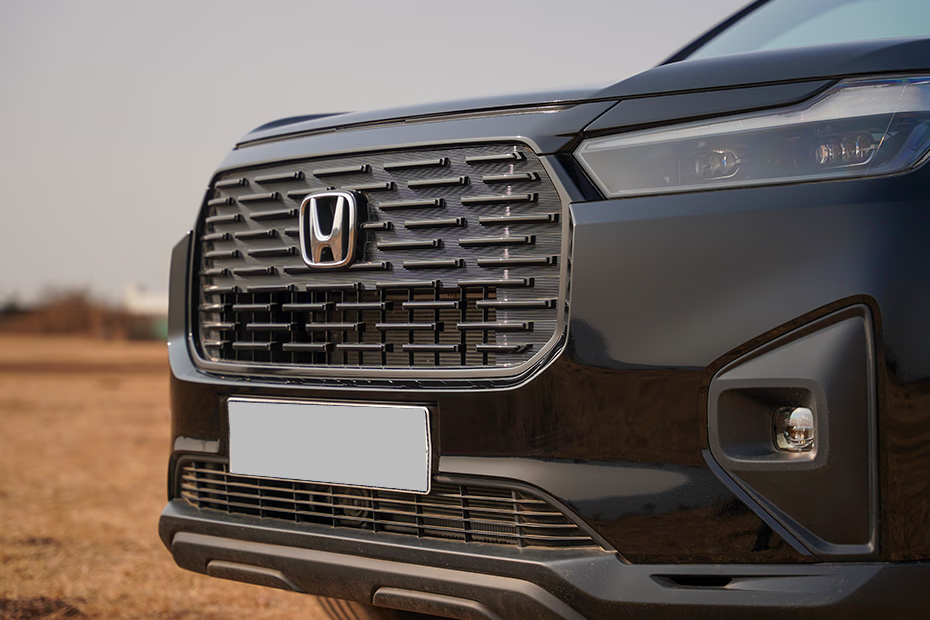
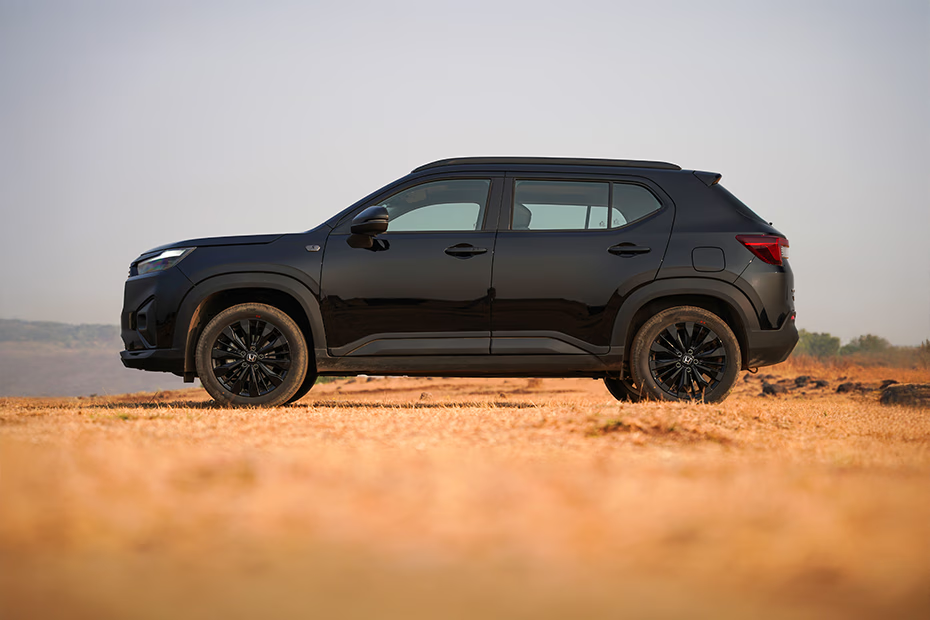
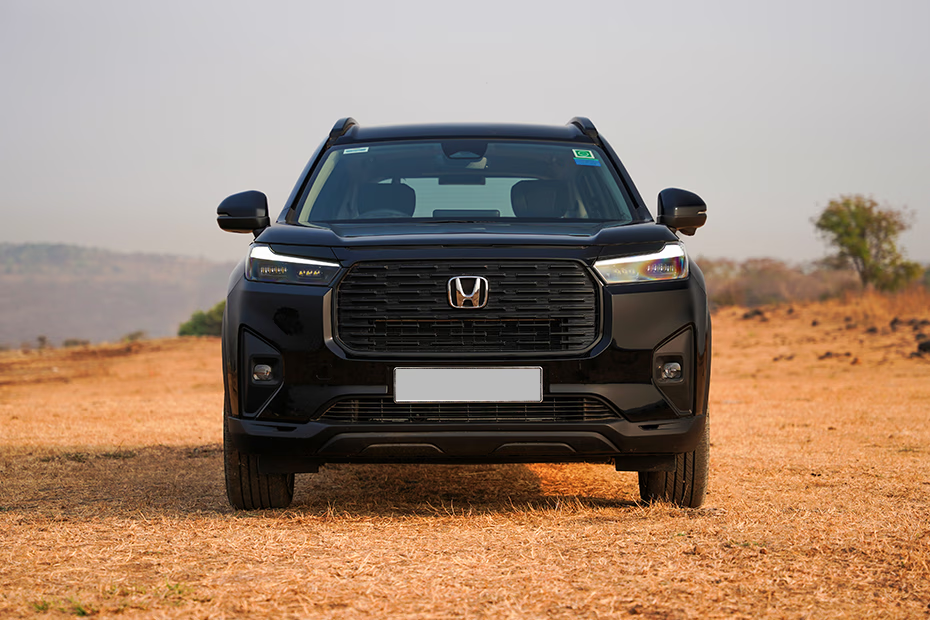
The ZX Black Edition and ADV Edition are style-first additions. The ADV (₹15.29–16.77 lakh) gets a blacked-out grille, orange accents, roof rails, and an earthier stance. If you want the Elevate to look less conservative, this is the one.
On-Road Price Across Cities — Why Bangalore Buyers Pay ₹4.36 Lakh More
The interactive table above shows city-wise on-road prices for the ZX CVT variant. The most important thing to understand is that Karnataka charges a significantly higher road tax rate than most other states — a buyer in Bangalore pays ₹4.36 lakh above ex-showroom on the ZX CVT, while a buyer in Mumbai pays only ₹2.65 lakh above. This is not Honda’s doing. It is purely the state RTO structure. Always get the exact on-road breakup in writing from the dealer before comparing prices across cities.
Honda Elevate Engine — The Most Honest Engine in Its Segment
The 1.5L i-VTEC: What It Is and What It Isn’t
The Elevate runs a 1,498cc, 4-cylinder naturally aspirated petrol engine making 121 PS at 6,600 rpm and 145 Nm at 4,300 rpm. It is the same engine that powers the Honda City sedan — a unit Honda has been refining since the mid-2000s and which now has an almost unimpeachable reputation for longevity and low maintenance cost.
What it is not is a turbo. The segment has shifted aggressively toward turbocharged engines — the Creta offers a 160 PS turbo-petrol, the Seltos matches it, the Kushaq and Taigun run 150 PS turbo units — and the Elevate deliberately sits out that race. Honda’s reasoning: a naturally aspirated engine has fewer components that can fail, costs less to service, delivers more predictable linear power delivery in city traffic, and does not require the premium fuel preference that many turbo engines develop over time.
In real-world Indian conditions — city traffic with constant stop-start, speed-breakers every 200 metres, potholes that launch your car sideways — the naturally aspirated engine is genuinely the more practical choice for 90% of buyers. Where you feel the absence is on national highways above 100 kmph when you need a quick overtake. The Elevate asks you to plan overtakes rather than execute them on instinct. If you do a lot of high-speed highway driving, this is a real compromise to consider. If your driving is primarily urban, it is almost irrelevant.
Manual vs CVT — Which One to Choose?
The 6-speed manual has short throws, a precise gate, and light clutch action — genuinely one of the better-feeling manuals in the segment. If you enjoy driving and your commute involves manageable traffic, the manual is the more engaging and slightly more fuel-efficient choice.
The CVT is Honda’s well-sorted unit and in real-world city traffic it is almost seamlessly smooth. Unlike some CVTs that feel rubber-band-like when you accelerate hard, the Elevate’s CVT responds predictably because the engine is not trying to make up for a turbo power gap. The CVT does make the car feel sluggish when you floor it from a standstill — which is CVT physics, not an Elevate-specific flaw. At city speeds, it is excellent.
Honda Elevate Mileage — ARAI vs Real World
The Honda Elevate’s official ARAI-claimed mileage is 16.92 kmpl for the CVT and 15.31 kmpl for the manual gearbox. Honda Car India Real-world experience from owners tells a more honest story:
In pure city driving with AC running and heavy stop-start traffic — Noida-Delhi, Outer Ring Road Bangalore, Western Express Highway Mumbai — owners consistently report 10–13 kmpl. One VX CVT owner reported 9–10 kmpl on the Noida-Delhi DND Flyway, which is heavy-traffic expressway driving where the CVT hunts for gears constantly.
On highways at a sensible cruise of 90–100 kmph, the Elevate returns 16–19 kmpl depending on terrain and AC load. Owners reporting 19+ kmpl are typically driving in mild weather on flat roads without heavy luggage.
The practical monthly fuel cost for a buyer doing 1,500 km/month with 70% city driving and 30% highway: at ₹95/litre petrol, you are looking at approximately ₹9,500–11,000 per month. The Maruti Grand Vitara strong hybrid would cut this to roughly ₹5,500–6,500 per month — a genuine ₹4,000/month saving that over 5 years is ₹2.4 lakh. That is the strongest rational argument for the hybrid Grand Vitara over the Elevate for high-mileage users. For buyers doing under 1,000 km/month, the fuel saving rarely justifies the Grand Vitara’s higher purchase price.
Honda Elevate Dimensions — The Numbers That Actually Matter
The segment is full of SUVs that look similar in photos and feel different in person. Here is what the Elevate’s dimensions mean in practice.
Wheelbase of 2,650 mm — this is the largest wheelbase in the segment and it directly translates to rear-seat legroom. Tall adults can sit behind tall adults in the Elevate without negotiation. It is one of the most practically spacious cabins at this price point for rear passengers.
Ground clearance of 220 mm — class-best. The next closest is the Grand Vitara at 210 mm, then the Nexon at 209 mm. The Creta and Seltos are at 190 mm. In Indian monsoon conditions, on broken city roads, and on non-metalled village roads, this 30mm difference versus the Koreans is meaningful. It is not a marketing number — it directly reduces the frequency of underbody scraping on the Elevate versus its rivals.
Boot space of 458 litres — again class-best. The Creta and Seltos offer 433 litres each, the Grand Vitara just 373 litres due to its hybrid battery pack eating into boot floor space. For families with luggage, prams, sports equipment, or grocery habits, 458 litres is noticeably more usable.
Where it loses: The rear seat width is tighter than the Creta and Seltos for three-abreast seating. Two adults sit very comfortably; three is a squeeze. The rear seat also lacks the reclining function that the Creta offers, which means on long journeys rear passengers are fixed in one position. The under-thigh support on the rear bench is also below segment average — a genuine ergonomic weakness Honda has not yet addressed.
Honda Elevate Safety — The Real Story Behind the Stars
Honda’s safety record in India is strong. The Elevate carries 6 airbags as standard on VX and above — that includes side airbags and curtain airbags, not just the frontal pair. On the SV and V variants, you only get 4 airbags.
Honda Sensing, the ADAS suite available from VX upward, includes:
- Collision Mitigation Braking System (camera-based, not radar)
- Lane Departure Warning and Lane Keeping Assist
- Road Departure Mitigation
- Adaptive Cruise Control
- Automatic High Beam
The important caveat is that Honda Sensing is camera-based only — it does not use radar. In heavy rain, fog, or glare conditions common on Indian highways, the camera-based system can become unreliable or switch off. It is still meaningfully better than no ADAS, but it is one generation behind the radar-plus-camera systems that the Seltos and newer Creta offer in their top variants. For daily city driving, this difference is academic. For long-distance drivers, it is worth knowing.
The Elevate also comes standard with VSA (Vehicle Stability Assist), Electronic Stability Control, Traction Control, Hill Start Assist, ABS with EBD and Brake Assist, and ISOFIX child seat anchors on all variants. The reinforced high-tensile steel body structure has a solid reputation — Honda cars hold their shape in side impacts particularly well.
Honda Elevate vs Hyundai Creta vs Kia Seltos — The Definitive Comparison
The interactive comparison table above has the full feature-by-feature breakdown at the equivalent top petrol automatic trim. Here is the editorial read:
Choose the Honda Elevate ZX CVT if: You want the most boot space and highest ground clearance in the segment, prioritise long-term reliability and low service costs over having the latest features, value Honda’s after-sales reputation for not upselling unnecessary work, or are a first-time SUV buyer who wants a car that is easy to live with for 7–10 years without drama.
The Elevate also makes strong sense if you are upgrading from a Honda City or Honda Jazz — the CVT feel, the driving dynamics, and the service network experience are continuous, not a jump to the unknown.
Choose the Hyundai Creta S(O) CVT if: You want a more feature-loaded cabin at the same price (ambient lighting, rain-sensing wipers, panoramic sunroof, and reclining rear seat are all absent on the Elevate), prefer a more refined interior with better quality plastics, or value Hyundai’s significantly wider service network — Hyundai has over 1,350 service touchpoints in India versus Honda’s approximately 400. In Tier 2 and Tier 3 cities, the Creta’s service accessibility advantage is genuinely meaningful.
Choose the Kia Seltos if: You want turbo-petrol performance, a more premium interior finish, or a more distinctive design. The Seltos is the most aspirational-looking car in this comparison and its DCT turbo-petrol variants are genuinely fun to drive on highways in a way the Elevate cannot match.
The honest bottom line: The Elevate is a no-nonsense family SUV that gets the fundamentals right — space, reliability, ground clearance, and practicality. It does not try to win on features or performance, but for the buyer who values long-term ownership confidence over brochure specifications, it is very hard to fault. The Creta and Seltos are more premium on the inside and more feature-rich at the same price. The Elevate’s edge is durability, boot space, ground clearance, and service simplicity.
Honda Elevate Ownership Cost — What You Actually Spend Over 5 Years
This is where the Elevate makes a case most competitors struggle to match.
Annual service cost: A basic service (oil change, filter, inspection) at a Honda dealership typically runs ₹6,000–8,000. Over 5 years and 4 services, expect to spend approximately ₹30,000–38,000 on scheduled maintenance — excluding tyres, brake pads, and accidental repair.
By comparison, Hyundai and Kia service costs run ₹8,000–12,000 per service visit for equivalent work. Over 5 years this is a difference of approximately ₹10,000–15,000 — not a dramatic gap, but consistent Honda owners note that the dealership experience tends to involve fewer surprise upsells.
Tyre costs: The SV and V get 205/65 R16 tyres. The VX gets 215/60 R16. The ZX and ADV get 215/55 R17 alloys. The 17-inch tyres cost approximately ₹8,000–10,000 per tyre from premium brands — budget ₹32,000–40,000 for a full tyre replacement at around the 50,000 km mark.
Resale value: The Elevate holds value well. After 3 years and 40,000 km, a well-maintained VX CVT typically commands ₹10–12 lakh in the used car market — a depreciation of approximately 25–30% from the original on-road price, which is in line with the Creta and slightly better than the Seltos. Honda’s reputation for reliability directly supports residual values.
Insurance: Comprehensive insurance for the ZX CVT (Delhi) runs approximately ₹55,000–65,000 in year one, dropping to ₹25,000–35,000 from year two after no-claims discount.
Honda Elevate Colours — All 9 Options Explained
The 2026 Elevate is available in 9 colour options:
| Colour | Single Tone | Dual Tone |
|---|---|---|
| Platinum White Pearl | Yes | Yes (+ Black roof) |
| Radiant Red Metallic | Yes | Yes (+ Black roof) |
| Crystal Black Pearl | Yes | — |
| Obsidian Blue Pearl | Yes | — |
| Golden Brown Metallic | Yes | — |
| Lunar Silver Metallic | Yes | — |
| Meteoroid Gray Metallic | Yes | — |
The dual-tone options (White and Red with black roof) carry a small premium of ₹10,000–15,000 and are exclusively available on ZX and ADV variants. Platinum White Pearl is the highest-selling colour nationally — it shows the Elevate’s family-car positioning most clearly and ages best in Indian sun. Obsidian Blue Pearl is the enthusiast choice — it photographs dramatically and is less common on the road.
Honda Elevate Pros and Cons — Our Verdict After 3 Years of Owner Data
Why You Should Buy It
The 220mm ground clearance is genuinely transformative on Indian roads. Owners who have upgraded from Creta or City report immediately noticing that the Elevate does not scrape on railway crossings, flyover joinings, and rough village roads that would have had them gritting their teeth before. This is not a marketing claim — it is consistently the most-cited real-world satisfaction point across hundreds of owner reviews.
The 1.5L engine’s long-term dependability record is unmatched in the segment. After 2.5 years on sale in India with tens of thousands of units on the road, there are no systemic engine, gearbox, or electronics reliability complaints of the sort that periodically surface about DCT, strong hybrid, and turbo-petrol variants from competitors. Honda’s dealer service experience is consistently rated higher for transparency than either Hyundai or Kia in urban markets.
The boot at 458 litres makes the Elevate the practical family car champion for anything involving luggage. Weekend trips, airport pickups, school holidays with four people’s bags — the Elevate handles it without roof-box discussions.
What It Gets Wrong
The absence of a panoramic sunroof when the Creta and Seltos offer it at the same price is a genuine miss. A single-pane sunroof in 2026 at ₹15+ lakh feels like a compromise Honda has not addressed.
Ambient lighting is completely absent across all variants. This is a feature that costs Honda almost nothing to add and which every buyer in this segment notices the first time they sit in a Creta or Seltos at night. The dark cabin at night makes the Elevate feel one generation behind.
The camera-only ADAS is a meaningful limitation for highway drivers. Radar is faster, more reliable in poor visibility, and longer range. Honda should offer a radar-based system on the ZX — it does not.
Rear seat comfort for three adults is genuinely below segment average. The rear seat does not recline, under-thigh support is limited, and the floor hump is pronounced. For a car with a best-in-class wheelbase, Honda has not optimised rear seat ergonomics as well as the space allows.
The dealer network gap in Tier 2 and Tier 3 cities is real. With approximately 400 service touchpoints versus Hyundai’s 1,350+, servicing the Elevate in smaller cities can mean driving 50–80 km to a Honda dealer.
Should You Buy the Honda Elevate in 2026?
Yes, buy it — if your priority list in order is: reliability, ground clearance, boot space, long-term ownership cost, and driving ease. The VX CVT at ₹14.91 lakh ex-showroom is the variant to buy — it delivers 6 airbags, ADAS, wireless charging, and Honda Sensing without the price escalation of the ZX. Plan for an on-road cost of ₹17.50–18.00 lakh depending on city.
Skip it and look at the Creta — if you care more about a feature-loaded cabin, a wider service network in your city, panoramic sunroof, ambient lighting, rear seat reclining, and a more premium interior feel. The Creta SX(O) CVT at ₹18.60 lakh is more expensive but genuinely more premium inside.
Skip it and look at the Seltos — if highway performance matters and you are willing to accept a smaller boot for a more exciting drive. The Seltos DCT turbo-petrol is a better driver’s car than the Elevate will ever be.
Skip it and look at the Grand Vitara — if you are a high-mileage driver covering 2,000+ km/month. The strong hybrid’s real-world 20–22 kmpl versus the Elevate’s 12–13 kmpl in city driving produces fuel savings that justify the price premium within 2 years at those mileage levels.
The Honda Elevate is not the most exciting SUV at this price. It is not the most feature-loaded. It is, however, the most reliably sensible — and for an Indian family buying a car they plan to keep for 8–10 years, sensible is underrated.
Honda Elevate — Key Specifications at a Glance
| Specification | Details |
|---|---|
| Engine | 1.5L i-VTEC 4-cylinder naturally aspirated petrol |
| Power / Torque | 121 PS @ 6,600 rpm / 145 Nm @ 4,300 rpm |
| Gearbox | 6-speed MT or CVT automatic |
| Seating | 5 |
| Length / Width / Height | 4,312 / 1,790 / 1,650 mm |
| Wheelbase | 2,650 mm |
| Ground clearance | 220 mm |
| Boot space | 458 litres |
| Fuel tank | 40 litres |
| ARAI mileage (CVT) | 16.92 kmpl |
| Price range (ex-showroom) | ₹11.60L – ₹16.77L |
| Warranty | 3 years / 1,00,000 km (extendable to 10 years) |
| Colours | 9 options (7 single tone, 2 dual tone) |
| Rivals | Hyundai Creta, Kia Seltos, Maruti Grand Vitara, Tata Nexon, Skoda Kushaq |
Frequently Asked Questions
Q1: What is the Honda Elevate price in India 2026?
The Honda Elevate price starts at ₹11.60 lakh for the SV variant and goes up to ₹16.77 lakh for the ADV Edition CVT Dual Tone, all ex-showroom India. On-road prices vary by city — in Delhi the ZX CVT costs approximately ₹19.24 lakh on-road.
Q2: Which Honda Elevate variant is best to buy?
The VX CVT at ₹14.91 lakh ex-showroom is the best value variant. It includes 6 airbags, Honda Sensing ADAS, wireless charging, a sunroof, and the 10.25-inch touchscreen — all the features that matter daily — at a price ₹1.34 lakh below the fully loaded ZX CVT.
Q3: Is Honda Elevate available in diesel?
No. The Honda Elevate is only available with a 1.5L naturally aspirated petrol engine in manual or CVT automatic. Honda offers a government-approved CNG kit retrofitment through authorised dealers for select variants, but there is no factory-fitted diesel or CNG option.
Q4: What is the Honda Elevate real-world mileage?
In city driving with AC, most owners report 10–13 kmpl. On highways at 90–100 kmph, the Elevate returns 16–19 kmpl. The CVT variant claims 16.92 kmpl (ARAI) and the manual claims 15.31 kmpl. Real-world figures are typically 20–25% below ARAI in Indian urban conditions.
Q5: Honda Elevate vs Hyundai Creta — which should I buy?
The Elevate wins on ground clearance (220mm vs 190mm), boot space (458L vs 433L), long-term reliability, and lower service costs. The Creta wins on interior features (ambient lighting, panoramic sunroof, rain-sensing wipers, reclining rear seat), dealer network breadth, and overall cabin premiumness. If you drive primarily in a large city and value features, the Creta. If you need the ground clearance and are planning 8+ years of ownership, the Elevate.
Page updated April 2026. Prices are ex-showroom India and subject to change. On-road prices are approximate and vary by state RTO rates, insurance selection, and dealer charges. Always confirm final prices with your nearest Honda dealership.