
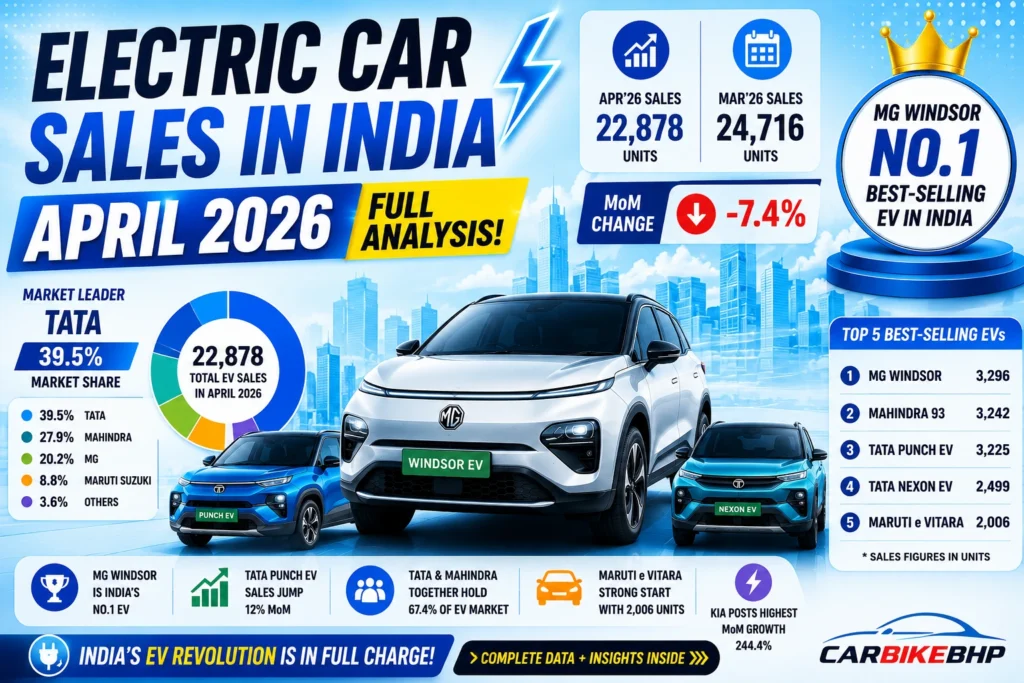
The Electric Car Sales in India April 2026 report paints an interesting picture for India’s fast-growing EV market. While total electric passenger vehicle sales stood at 22,878 units, the segment recorded a 7.4% month-on-month (MoM) decline compared to 24,716 units sold in March 2026. However, despite this short-term slowdown, the bigger story remains the intensifying competition between traditional players like Tata Motors and emerging challengers such as Mahindra and MG Motor.
April is traditionally a slower month for the Indian automotive market due to year-end inventory corrections, revised pricing, and consumer purchase cycles following March-end buying activity. Therefore, a moderate dip does not necessarily signal weakness in EV demand. Instead, it reflects temporary market normalization after aggressive March deliveries.
For Indian buyers in cities like Bangalore, Delhi NCR, Mumbai, Pune, Chennai, and Hyderabad—where EV adoption remains strongest—the April sales data confirms that electric cars are steadily becoming mainstream. Consumers increasingly value lower running costs, government incentives, smoother city drivability, and freedom from rising petrol and diesel prices.
However, one major surprise in the Electric Car Sales in India April 2026 data was the rise of the MG Windsor, which overtook established rivals to become India’s best-selling electric car for the month.
OEM-Wise Electric Car Sales In India April 2026
Tata Motors retained its leadership position in India’s EV market during April 2026, although the company experienced a slight decline in monthly sales. Meanwhile, Mahindra continued strengthening its position as India’s second-largest EV player, while MG Motor secured third place with impressive performance from the Windsor EV.
OEM-Wise Electric Car Sales – April 2026
| Rank | OEM | Apr’26 Sales | MoM Change | Market Share |
|---|---|---|---|---|
| 1 | Tata | 9,041 | -2.7% | 39.5% |
| 2 | Mahindra & Mahindra | 6,386 | -6.5% | 27.9% |
| 3 | MG Motor | 4,614 | -17.9% | 20.2% |
| 4 | Maruti Suzuki | 2,006 | -11.0% | 8.8% |
| 5 | Hyundai | 539 | -10.2% | 2.4% |
| 6 | Kia | 279 | +244.4% | 1.2% |
| 7 | Citroen | 13 | -65.8% | 0.1% |
Total EV Sales
22,878 units (-7.4% MoM)
The numbers clearly show that Tata remains India’s EV king, accounting for nearly 40% market share. However, Mahindra is closing the gap rapidly, helped by strong traction for newer EV products.
Interestingly, Tata and Mahindra together accounted for nearly 67.4% of all EV sales during April 2026, effectively making this a two-player race for dominance.
Tata Motors Continues To Lead – But Competition Is Growing
Tata Motors retained its leadership in Electric Car Sales in India April 2026, selling 9,041 EVs and capturing 39.5% market share.
Top Tata EV Contributors
| Model | Apr’26 Sales |
|---|---|
| Tata Punch EV | 3,225 |
| Tata Nexon EV | 2,499 |
| Tata Harrier EV | 1,690 |
| Tata Curvv EV | 882 |
Tata’s strategy continues to revolve around offering electric vehicles across multiple price brackets. From compact urban EVs like the Punch EV to premium offerings like the Harrier EV and Curvv EV, Tata currently enjoys one of the strongest product portfolios in India.
However, April’s sales reveal an important shift. Tata’s dominance remains intact, but rivals are becoming increasingly competitive. The relatively modest 2.7% decline MoM also suggests Tata has managed inventory and market demand more efficiently than many competitors.
For Indian families seeking affordable EV ownership, Tata still remains the default choice because of widespread service reach, trusted safety credentials, and lower ownership anxiety.
Mahindra Strengthens Position With Premium Electric SUVs
Mahindra & Mahindra delivered another strong performance in Electric Car Sales in India April 2026, selling 6,386 units.
Top Mahindra EV Sales
| Model | Apr’26 Sales | MoM |
|---|---|---|
| Mahindra 9S | 3,242 | 0% |
| Mahindra XEV 9e | 1,611 | -8% |
| Mahindra BE6 | 1,170 | -22% |
Mahindra’s EV strategy differs significantly from Tata’s.
Instead of focusing primarily on affordability, Mahindra has targeted aspirational premium electric SUVs. This appears to be working well, especially among urban buyers wanting larger SUVs without fuel costs.
Cities like Bangalore and Gurgaon continue seeing stronger demand for premium EVs due to better charging infrastructure and higher disposable incomes.
MG Windsor Becomes India’s Best-Selling EV
The biggest headline from the Electric Car Sales in India April 2026 report is undoubtedly the rise of the MG Windsor.
Top 10 Best-Selling EVs – April 2026
| Rank | Model | OEM | Apr’26 Sales | MoM |
|---|---|---|---|---|
| 1 | MG Windsor | MG | 3,296 | -27% |
| 2 | Mahindra 93 | M&M | 3,242 | 0% |
| 3 | Tata Punch EV | Tata | 3,225 | +12% |
| 4 | Tata Nexon EV | Tata | 2,499 | -4% |
| 5 | Maruti e Vitara | Maruti Suzuki | 2,006 | -11% |
| 6 | Tata Harrier EV | Tata | 1,690 | 6% |
| 7 | Mahindra XEV 9e | M&M | 1,611 | -8% |
| 8 | Mahindra BE6 | M&M | 1,170 | -22% |
| 9 | Tata Curvv EV | Tata | 882 | -27% |
| 10 | MG ZS EV | MG | 717 | +74% |
Despite recording a 27% MoM decline, the MG Windsor still emerged as India’s best-selling electric car, proving the vehicle has struck a chord with Indian buyers.
Its appeal lies in offering premium SUV styling, urban usability, and accessible pricing.
Maruti Suzuki e Vitara Makes Strong Impact
One of the biggest emerging stories is the performance of the Maruti Suzuki e Vitara, which sold 2,006 units in April 2026.
Maruti Suzuki entering the EV market seriously could reshape the entire industry.
Historically, Indian consumers trust Maruti for reliability, service access, and affordable ownership. If the company expands EV offerings aggressively, adoption may accelerate significantly in tier-2 and tier-3 cities.
Hyundai, Kia & Citroen Still Struggle In EV Volumes
Lower Volume Players
| Brand | Sales | Market Share |
|---|---|---|
| Hyundai | 539 | 2.4% |
| Kia | 279 | 1.2% |
| Citroen | 13 | 0.1% |
Despite global EV expertise, these brands still struggle for scale in India.
Price sensitivity remains a major barrier.
What April 2026 EV Sales Mean For India
Key Market Trends
- Tata remains dominant
- Mahindra gaining rapidly
- MG Windsor becoming serious challenger
- Maruti EV entry reshaping market
- Premium EV demand rising
For Indian buyers, competition means:
- Better range
- Lower pricing pressure
- Faster charging tech
- More premium features
Verdict
The Electric Car Sales in India April 2026 report confirms one thing clearly—India’s EV market is no longer a one-brand story.
While Tata Motors still leads comfortably, challengers like Mahindra and MG are becoming increasingly serious threats. The rise of the MG Windsor and Maruti e Vitara also signals that buyers are willing to experiment beyond traditional leaders.
Even though total EV sales declined slightly in April, the long-term momentum remains firmly positive. With stronger products, improving charging infrastructure, and increasing awareness, India’s electric future appears closer than ever.