
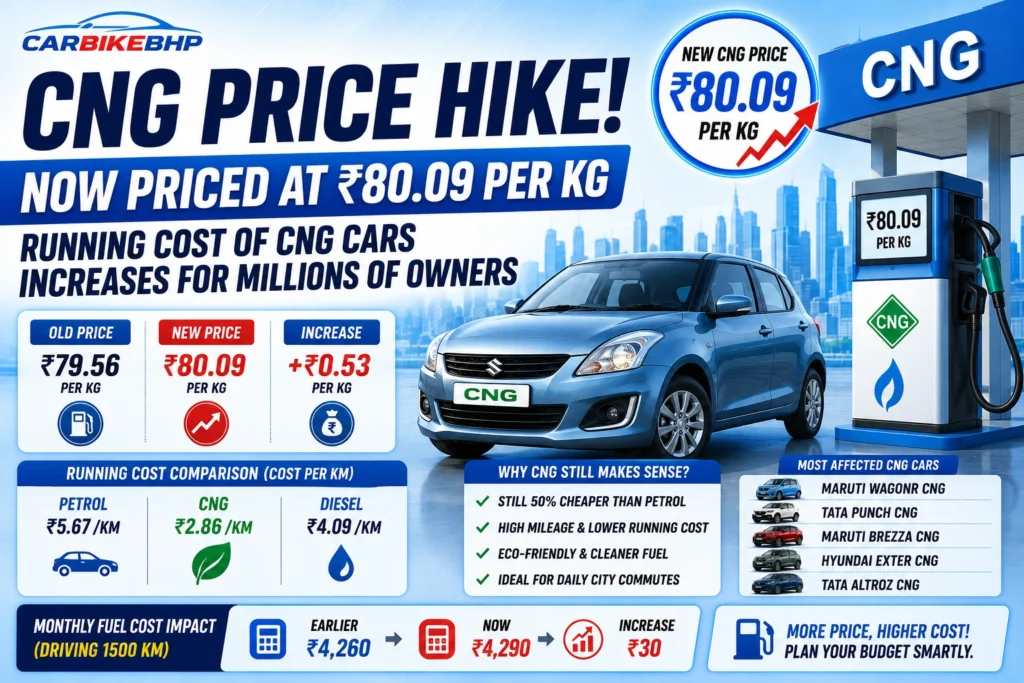
Indian CNG car owners will now have to spend more on daily commuting as compressed CNG price hike to ₹80.09 per kg, directly impacting the running cost of millions of vehicles across the country. The latest price revision primarily affects cities where CNG adoption has grown rapidly, including Delhi NCR, Mumbai, Pune, Ahmedabad, Hyderabad, and Bengaluru. For many middle-class buyers who switched from petrol to CNG specifically to reduce monthly fuel bills, this hike raises an important question—does CNG still make financial sense in 2026?
The answer is not as straightforward as it may initially seem. While running costs have certainly increased, CNG still remains significantly cheaper than petrol for most users. However, the financial advantage has narrowed slightly compared to previous years. This becomes particularly important for Indian office commuters, cab operators, and high-mileage drivers who rely on CNG-powered vehicles to manage ownership expenses.
For automakers such as Maruti Suzuki, Tata Motors, and Hyundai Motor India, the long-term impact of rising CNG prices could influence future demand patterns. Yet, despite higher fuel prices, CNG remains an extremely important alternative in a market where petrol prices continue hovering near uncomfortable levels.
Also read – India Auto Dealers Warn Iran War May Disrupt Vehicle Supplies, Prices Likely to Rise
Why CNG Prices Are Increasing In India
The latest CNG price hike did not happen in isolation. Fuel pricing in India depends on multiple global and domestic variables, including natural gas procurement costs, import dependency, currency fluctuations, infrastructure costs, and government regulations.
Key Reasons Behind The CNG Price Hike
| Factor | Impact |
|---|---|
| Higher Natural Gas Costs | Increased sourcing expenses |
| Import Dependence | Vulnerability to global pricing |
| Infrastructure Expansion | Pipeline & station costs |
| Distribution Charges | Higher operational costs |
India’s dependence on imported energy continues influencing pricing trends across fuels. While domestic production supports part of the demand, a large portion of natural gas still depends on international pricing conditions.
Another major reason is the growing popularity of CNG itself. Demand has expanded rapidly because manufacturers increasingly offer factory-fitted CNG options in affordable vehicles. As more users shift to CNG, infrastructure expansion costs—including stations, storage, and distribution—also rise.
That said, unlike petrol and diesel, CNG still benefits from a perception of affordability among urban Indian commuters.
Old Vs New CNG Price – What Changed?
The biggest concern for consumers naturally revolves around actual fuel price differences.
Old Vs New CNG Price
| Fuel | Previous Price | New Price |
|---|---|---|
| CNG | ₹79.56/kg | ₹80.09/kg |
While the increase of around ₹0.53/kg may appear small on paper, high-mileage users feel cumulative effects more strongly.
For example, a commuter driving 1,500–2,000 km per month will eventually notice the increase in monthly fuel bills.
However, context matters.
Petrol prices in most Indian cities still hover around ₹95–₹110/litre, meaning CNG retains a strong cost advantage despite the latest hike.
This is precisely why many buyers continue preferring factory-fitted CNG vehicles, especially for city-focused commuting and daily office runs.
Running Cost Impact – How Much More Will You Spend?
The most practical way to understand the impact of the CNG price hike is through real-world running cost calculations.
Running Cost Before Vs After Price Hike
| Car Type | Mileage | Earlier Cost/Km | New Cost/Km |
|---|---|---|---|
| Small Hatchback | 28 km/kg | ₹2.84/km | ₹2.86/km |
| Compact Sedan | 26 km/kg | ₹3.05/km | ₹3.08/km |
| Compact SUV | 24 km/kg | ₹3.31/km | ₹3.34/km |
The difference per kilometre may look marginal, but over time the cumulative cost becomes noticeable.
Monthly Fuel Cost Impact
| Monthly Driving | Earlier Spend | New Spend |
|---|---|---|
| 1,000 km | ₹2,840 | ₹2,860 |
| 1,500 km | ₹4,260 | ₹4,290 |
| 2,000 km | ₹5,680 | ₹5,720 |
For most private owners, the increase remains manageable. However, commercial operators such as taxi fleets and app-based cabs could feel greater pressure because margins depend heavily on running costs.
In cities such as Delhi and Mumbai, where average daily commutes are often lengthy, even smaller increases become more visible over months.
Also read – Electric Car Sales In India April 2026 – Market Declines But Competition Intensifies
Petrol Vs CNG Vs Diesel – Which Fuel Still Makes Sense?
One major question after the CNG price hike is whether buyers should continue considering CNG over petrol or diesel.
Fuel Cost Comparison Per Km
| Fuel Type | Fuel Price | Mileage | Cost/Km |
|---|---|---|---|
| Petrol | ₹102/litre | 18 km/l | ₹5.67/km |
| Diesel | ₹90/litre | 22 km/l | ₹4.09/km |
| CNG | ₹80.09/kg | 28 km/kg | ₹2.86/km |
The difference remains significant.
Despite rising prices, CNG still costs nearly 50% less than petrol in running expense terms.
This means urban commuters covering heavy mileage will continue benefiting financially.
For instance, office commuters travelling Gurgaon–Noida daily or frequent intercity users between Pune–Mumbai could still save thousands annually.
Most Affected CNG Cars In India
Popular Factory-Fitted CNG Cars
| Model | Mileage |
|---|---|
| Maruti WagonR CNG | 34 km/kg |
| Maruti Brezza CNG | 25 km/kg |
| Tata Punch CNG | 27 km/kg |
| Hyundai Exter CNG | 27 km/kg |
| Tata Altroz CNG | 26 km/kg |
Vehicles with lower mileage naturally feel greater impact from rising prices.
However, most modern CNG cars remain substantially cheaper to operate than petrol alternatives.
Should Buyers Still Buy CNG Cars In 2026?
The answer depends largely on driving pattern.
Buy A CNG Car If:
- You drive 1,000+ km monthly
- City commuting dominates usage
- Fuel savings matter significantly
Avoid CNG If:
- Highway touring dominates
- Boot space matters heavily
- Annual usage remains low
For Indian middle-class families, CNG still makes tremendous financial sense.
Impact On Maruti, Tata & Hyundai CNG Strategy
Manufacturers increasingly rely on CNG demand.
Brand CNG Focus
| Brand | Strategy |
|---|---|
| Maruti Suzuki | Largest CNG portfolio |
| Tata Motors | Twin-cylinder tech |
| Hyundai | Urban family buyers |
Despite rising prices, automakers are unlikely to slow CNG expansion.
Verdict
The latest CNG price hike to ₹80.09/kg will undoubtedly increase ownership costs for millions of users, but it does not fundamentally destroy CNG’s biggest advantage—affordability.
Even after the revision, CNG cars remain dramatically cheaper to run than petrol vehicles, especially for high-mileage users.
For Indian buyers focused on saving money during daily commutes, CNG still remains one of the smartest ownership decisions in 2026. However, future price hikes may gradually narrow the cost advantage, making hybrids and affordable EVs increasingly attractive alternatives.