
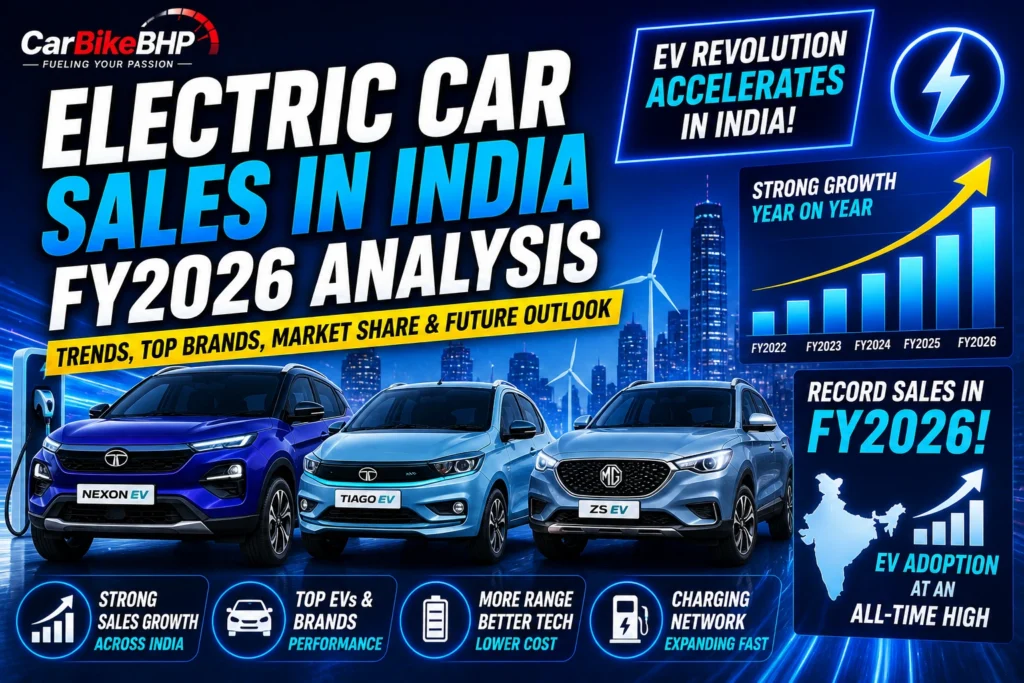
The Electric Car Sales India FY2026 data shows a strong upward trend, with EV adoption accelerating across major cities and even Tier-2 markets. The Indian EV market is no longer niche—it is steadily becoming a mainstream choice for urban buyers.
With rising fuel prices, government incentives, and improved charging infrastructure, more buyers in cities like Delhi, Mumbai, Bangalore, and Hyderabad are seriously considering electric cars for daily commuting.
Total EV Sales and Growth Trends in FY2026
The Electric Car Sales India FY2026 numbers indicate:
- Strong year-on-year growth compared to FY2025
- Increasing share of EVs in total passenger vehicle sales
- Higher adoption in metro cities
Key Observations:
- EV penetration is still low overall but growing fast
- Urban buyers dominate EV adoption
- Fleet operators and ride-sharing services are major contributors
This growth is largely driven by practical use cases like office commute and city driving, where EVs make the most sense.
Brand-Wise Market Share – Who Is Leading EV Sales in India
The Electric Car Sales India FY2026 market is currently led by a few key players.
Top EV Brands:
- Tata Motors
- MG Motor India
- Mahindra Electric
Market Insights:
- Tata Motors continues to dominate with multiple EV offerings
- MG focuses on premium EV buyers
- Mahindra is slowly expanding its EV portfolio
Tata’s early-mover advantage and aggressive pricing strategy have helped it capture a significant share of the market.
OEM Share in Electric Car Market – FY2026
| OEM | Sales | Share |
| Tata Motors | 85,405 | ~38.8% |
| MG Motor | 62,591 | ~28.4% |
| Mahindra | 54,626 | ~24.8% |
| Hyundai | 5,748 | ~2.6% |
| Kia | 4,485 | ~2.0% |
| Maruti Suzuki | 3,652 | ~1.7% |
| Others | ~600 | ~0.3% |
Top Selling Electric Cars in India FY2026
Several models have played a key role in boosting Electric Car Sales India FY2026.
Best-Selling EVs:
- Tata Nexon EV
- Tata Tiago EV
- MG ZS EV
- Mahindra XUV400
Why These Cars Are Popular:
- Affordable entry-level options (Tiago EV)
- Practical range for city use (Nexon EV)
- Premium features (MG ZS EV)
For Indian buyers, especially those driving 30–50 km daily, these EVs offer a significant reduction in running costs.
Segment-Wise EV Sales Breakdown
The Electric Car Sales India FY2026 data shows clear trends across segments.
1. Entry-Level EVs (₹8–₹12 lakh)
- Growing rapidly due to affordability
- Popular among first-time EV buyers
2. Mid-Range EVs (₹12–₹20 lakh)
- Dominated by Nexon EV and XUV400
- Best balance of price and range
3. Premium EVs (₹20 lakh+)
- Smaller share but growing steadily
- Focus on tech and performance
This segmentation shows that affordability is still the biggest driver for EV adoption in India.
City-Wise EV Adoption Trends
EV adoption is highly concentrated in urban areas.
Top EV Cities:
- Delhi NCR
- Mumbai
- Bangalore
- Hyderabad
- Pune
Why These Cities Lead:
- Better charging infrastructure
- Higher fuel prices
- More awareness about EV benefits
In smaller cities, adoption is slower due to infrastructure challenges.
Modelwise Sales of Electric Passenger Cars in FY2026:
| Rank | OEM | Model | FY2026 Nos | Contribution% |
| 1 | Morris Garage | Windsor | 46,720 | 21.2% |
| 2 | Tata | Nexon | 29,197 | 13.3% |
| 3 | Mahindra | XEV 9e | 27,336 | 12.4% |
| 4 | Tata | Harrier | 17,590 | 8.0% |
| 5 | Tata | Punch | 17,117 | 7.8% |
| 6 | Mahindra | BE 6 | 16,313 | 7.4% |
| 7 | Tata | Tiago | 14,697 | 6.7% |
| 8 | Morris Garage | Comet | 10,292 | 4.7% |
| 9 | Mahindra | 9S | 7,896 | 3.6% |
| 10 | Tata | Curvv | 6,964 | 3.2% |
| 11 | Morris Garage | ZS EV | 5,579 | 2.5% |
| 12 | Hyundai | Creta | 5,563 | 2.5% |
| 13 | Kia | Carens | 4,483 | 2.0% |
| 14 | Maruti Suzuki | eVitara | 3,652 | 1.7% |
| 15 | Tata | Tigor | 2,840 | 1.3% |
| 16 | Mahindra | XUV 400 | 2,400 | 1.1% |
| 17 | Mahindra | XUV 3X0 | 681 | 0.3% |
| 18 | Citroen | Ë C3 | 598 | 0.3% |
| 19 | Hyundai | IONIQ 5 | 185 | 0.1% |
| 20 | Kia | EV9 | 2 | 0.0% |
| TOTAL | 2,20,105 |
Why Electric Car Sales India FY2026 Is Growing
Several factors are pushing EV growth:
1. Rising Fuel Prices
Petrol prices above ₹100/litre make EVs more attractive.
2. Lower Running Costs
Electric cars cost significantly less per km compared to petrol/diesel cars.
3. Government Incentives
Subsidies under FAME schemes reduce initial cost.
4. Improved Charging Infrastructure
More public charging stations are being installed.
5. Better Product Options
Manufacturers now offer EVs across multiple price segments.
Challenges Slowing EV Adoption in India
Despite growth, there are still challenges:
1. Charging Infrastructure Gaps
Not all areas have easy access to charging stations.
2. Higher Initial Cost
EVs are still more expensive than petrol cars upfront.
3. Range Anxiety
Buyers worry about running out of charge on highways.
4. Limited Model Options
Compared to petrol cars, EV choices are still limited.
Rivals and Market Competition
The EV market is becoming increasingly competitive.
Key Competition:
- Hyundai Kona Electric
- BYD Atto 3
- Citroen eC3
Market Direction:
- More global brands entering India
- Increasing focus on affordable EVs
- Expansion of charging networks
What It Means for Buyers
For Indian buyers, the Electric Car Sales India FY2026 trend highlights:
- EVs are becoming more practical for daily use
- Running cost savings are significant
- More options will be available soon
However, buyers should still consider:
- Charging availability in their area
- Daily driving needs
- Total cost of ownership
Future Outlook for Electric Cars in India
The future of Electric Car Sales India FY2026 looks promising.
Expected Developments:
- More affordable EVs under ₹10 lakh
- Expansion of charging infrastructure
- Increased competition leading to better products
- Growth in long-range EV options
EV adoption is expected to accelerate further in the next 3–5 years.
Verdict
The Electric Car Sales India FY2026 analysis clearly shows that India’s EV market is entering a growth phase. While challenges remain, the overall direction is positive.
For urban buyers, EVs are already a practical alternative to petrol cars. For others, it may take a bit more time as infrastructure improves.
If current trends continue, electric cars could soon become a common sight on Indian roads—not just in metros but across the country.