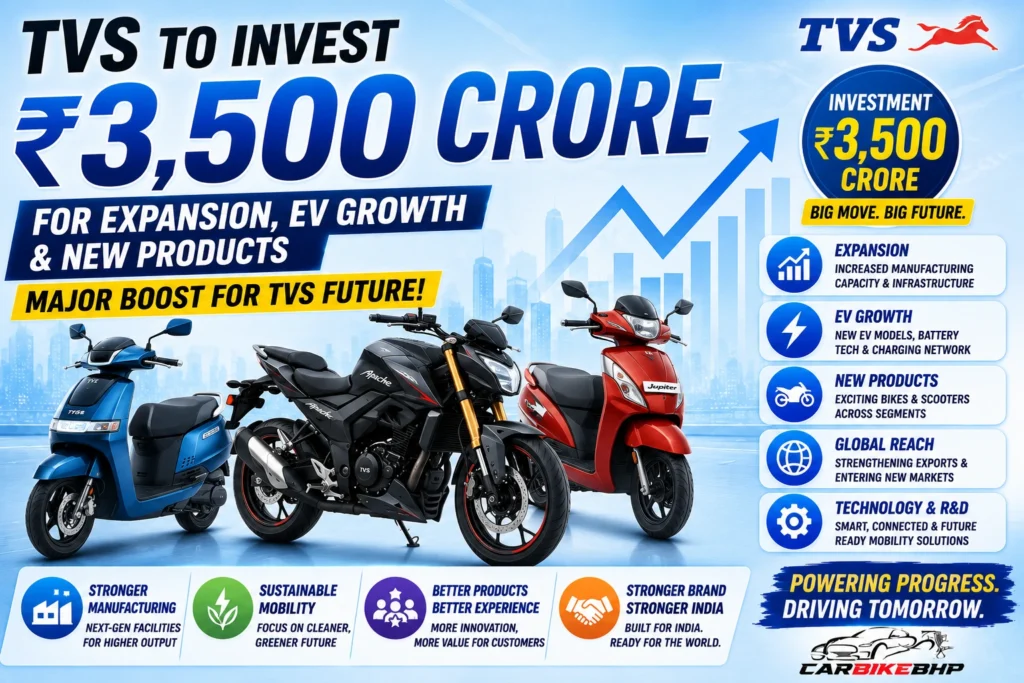
TVS Motor Company has announced an ambitious TVS ₹3,500 crore expansion strategy, signalling one of the company’s biggest long-term investment moves in recent years. The investment will reportedly be directed toward new product development, electric vehicle growth, manufacturing expansion, premium motorcycles, and international business opportunities. At a time when India’s two-wheeler market is rapidly evolving due to electrification, stricter emission regulations, and changing buyer preferences, this announcement shows that TVS is preparing aggressively for the next phase of growth rather than simply defending its existing market share.
For Indian buyers, this development matters more than it may initially appear. TVS already has strong positioning across scooters, commuter motorcycles, premium performance bikes, and electric mobility. Products such as the TVS Apache RTR 310, TVS Jupiter, and TVS iQube have helped the brand steadily strengthen its reputation across multiple categories. However, with rivals aggressively expanding their EV line-ups and premium offerings, TVS clearly understands that remaining competitive over the next decade requires substantial investment.
For everyday Indian consumers—whether in metro cities like Bangalore, Pune, Chennai, Delhi NCR, or tier-2 cities—this investment could eventually translate into more affordable EVs, better premium motorcycles, stronger dealership networks, and advanced technology in future TVS vehicles.
Why TVS Is Investing ₹3,500 Crore Right Now
The timing of the TVS ₹3,500 Crore Expansion is not accidental. India’s automotive industry, especially the two-wheeler market, is currently undergoing a major transformation. Consumer expectations have shifted dramatically over the last five years. Earlier, buyers mainly cared about mileage and affordability. Today, younger riders increasingly prioritize performance, premium styling, technology, connectivity, and sustainability.
Key Reasons Behind TVS Expansion
| Factor | Why It Matters |
|---|---|
| EV Growth | Rising electric scooter demand |
| Premium Bikes | Growing enthusiast market |
| Exports | New international opportunities |
| Manufacturing | Capacity expansion |
| Technology | Smarter connected vehicles |
TVS also faces intensifying pressure from competitors. Legacy brands are reinventing themselves, while newer startups continue attracting younger buyers. Companies such as Ola Electric, Ather Energy, and traditional giants like Bajaj Auto are investing heavily in future mobility.
Unlike many rivals, TVS appears focused on maintaining balance—investing in both ICE and electric mobility instead of abandoning conventional motorcycles too quickly. That balanced approach could prove highly beneficial in a market like India where EV adoption still varies significantly between regions.
How TVS Plans To Spend ₹3,500 Crore
While TVS has not publicly broken down every rupee of the announced ₹3,500 crore expansion, reports indicate that the money will likely be spread across multiple business priorities.
Expected Investment Areas
| Area | Expected Focus |
|---|---|
| EV Business | New iQube & future EVs |
| Manufacturing | Factory expansion |
| Premium Motorcycles | Apache, Norton development |
| R&D | Software & connected tech |
| Global Markets | Export growth |
The EV segment is expected to receive a meaningful portion of this investment because the market remains highly competitive and rapidly evolving. However, TVS is unlikely to neglect its traditional commuter segment either because petrol-powered scooters and motorcycles still dominate volumes in India.
From a business standpoint, this diversification strategy makes sense. Depending too heavily on EVs right now could become risky because charging infrastructure remains inconsistent outside larger cities.
For TVS, balancing profitability from petrol vehicles while gradually expanding EV presence appears to be the smarter long-term approach.
EV Growth Could Become TVS’ Biggest Focus Area
The strongest signal emerging from the TVS ₹3,500 Crore Expansion plan is clearly EV ambition.
TVS has already achieved encouraging success with the TVS iQube, which has become one of India’s top-selling electric scooters. Unlike some newer startups that faced quality and service-related criticism, TVS benefited from its established dealership network and stronger trust among Indian consumers.
TVS EV Portfolio Today
| EV Model | Segment |
|---|---|
| TVS iQube | Electric Scooter |
| TVS X | Premium Electric Scooter |
Future EV Expectations
| Category | Possibility |
|---|---|
| Affordable EV Scooter | Highly Likely |
| Premium Electric Bike | Expected |
| Family EV Scooter | Possible |
| Performance EV | Long-Term |
For urban riders in cities such as Bangalore or Hyderabad, EV scooters increasingly make practical sense because of lower running costs and easier commuting. Daily office riders travelling 20–40 km often spend dramatically less on electricity compared to petrol.
That said, rural and semi-urban buyers may continue preferring petrol-powered vehicles for reliability and refuelling convenience. TVS seems aware of this reality.
New TVS Bikes & Scooters Could Be Coming Soon
One of the most exciting aspects of the TVS ₹3,500 Crore Expansion is the possibility of entirely new motorcycles and scooters.
Expected New TVS Products
| Product Type | Expected Launch Focus |
|---|---|
| Premium Bikes | Apache expansion |
| Adventure Motorcycles | Growing possibility |
| New Scooters | Family urban mobility |
| EV Motorcycles | Future roadmap |
TVS has been increasingly successful in building enthusiast-focused products. The Apache range now enjoys strong credibility among performance-oriented Indian buyers.
Meanwhile, scooters like the Jupiter continue attracting practical family buyers because of comfort, fuel efficiency, and reliability.
This means TVS now competes effectively in both emotional and practical purchase categories—a major strength compared to some competitors.
There is also growing speculation that premium motorcycles linked to the Norton partnership could eventually influence Indian products, especially in design and engineering.
Premium Motorcycle Strategy – Apache & Norton Could Benefit
TVS has quietly strengthened its premium image over recent years.
The acquisition of Norton Motorcycles gave TVS access to premium engineering and global motorcycle heritage.
Premium TVS Strategy
For younger Indian riders increasingly interested in lifestyle-oriented motorcycles, premium positioning matters significantly.
Bikes are no longer viewed only as commuting tools. They increasingly represent identity, passion, and weekend lifestyle experiences.
This creates major opportunity for TVS.
Global Expansion Is Also A Big Priority
TVS is not thinking only about India.
The ₹3,500 crore investment is also expected to strengthen international operations.
TVS Export Strategy
| Region | Opportunity |
|---|---|
| Africa | Commuter bikes |
| Latin America | Growing demand |
| Southeast Asia | Scooters & commuters |
| Europe | Norton premium products |
International expansion helps reduce dependence on Indian market fluctuations.
What This Means For Indian Buyers
For consumers, this investment could mean:
- More feature-rich motorcycles
- Better EV choices
- Improved dealership support
- Stronger premium product options
- More competitive pricing
Competition ultimately benefits buyers.
TVS Vs Rivals – Future Competition Will Intensify
Key Rivals
| Brand | Strength |
|---|---|
| Bajaj Auto | Performance bikes |
| Hero MotoCorp | Massive reach |
| Ola Electric | EV scale |
| Ather Energy | Technology |
TVS is positioning itself to compete across every segment.
Verdict
The TVS ₹3,500 Crore Expansion is more than a financial announcement—it is a clear indication that TVS wants to play aggressively across every important future mobility category.
Whether it is EVs, premium motorcycles, exports, or smarter connected products, TVS appears determined to strengthen its position before competition becomes even tougher.
For Indian buyers, the biggest winners may ultimately be consumers themselves because stronger competition usually means better products, better pricing, and more innovation.