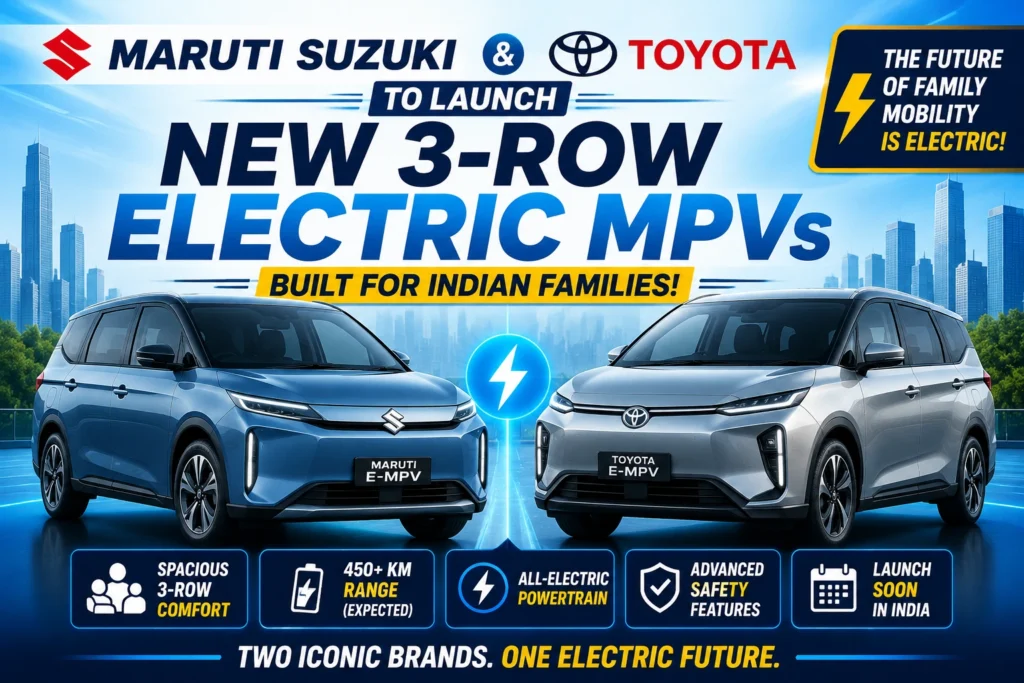
Maruti Suzuki and Toyota 3-Row Electric MPVs are shaping up to become some of the most important upcoming family EV launches for India. According to recent reports, both brands are working on new electric three-row people movers aimed at buyers seeking practicality, spaciousness, premium comfort, and lower running costs. Unlike compact EV hatchbacks and SUVs dominating the market today, these new electric MPVs will specifically target larger families—an area where India still lacks strong electric choices.
The development is particularly important because India’s EV transition is entering a new phase. Early adopters largely focused on compact city EVs such as the Tata Nexon EV, MG Windsor EV, and Mahindra XUV400. However, as charging infrastructure gradually improves and ownership confidence increases, manufacturers are beginning to explore larger body styles. The upcoming Maruti Suzuki and Toyota 3-Row Electric MPVs could therefore create an entirely new segment for electric family mobility.
For Maruti Suzuki, the project reflects a serious attempt to accelerate its EV ambitions after years of cautious planning. For Toyota, this move complements its hybrid leadership strategy while strengthening future EV positioning in India.
Also read – Maruti YMC 7-Seat Electric MPV Set For India Launch This Fiscal Year
Why Maruti Suzuki and Toyota Are Betting Big On Electric MPVs
The biggest question many buyers will ask is simple—why electric MPVs?
The answer lies in India’s changing family mobility preferences.
SUVs continue dominating sales charts, but many Indian buyers still prioritize cabin practicality over rugged styling. Three-row vehicles remain highly popular among joint families, business owners, chauffeur-driven users, airport transfer operators, and premium urban buyers who regularly travel with passengers and luggage.
Why Electric MPVs Make Sense In India
| Factor | Impact |
|---|---|
| Family Demand | Growing |
| Fuel Cost Savings | Major Advantage |
| Fleet Usage | Strong Potential |
| EV Running Cost | Significantly Lower |
| Government Push | Positive |
The upcoming Maruti Suzuki and Toyota 3-Row Electric MPVs could especially appeal to buyers currently choosing vehicles like the Toyota Innova Hycross, Kia Carens, or premium seven-seat SUVs.
Electric MPVs also make financial sense for high-mileage owners.
Fleet operators, corporate transportation businesses, premium cab providers, and airport shuttle services could benefit significantly from lower operational costs.
If Maruti and Toyota price these vehicles competitively, demand could rise quickly.
Also read – Maruti 7-Seater Electric MPV Could Become India’s Most Practical Family EV
Design Details & Platform Expectations
Although official design images remain unavailable, reports indicate that both brands are likely developing spacious electric MPVs with family practicality as the primary focus.
Expected Design Highlights
| Feature | Expected |
|---|---|
| Large Cabin Space | Likely |
| EV-Specific Styling | Expected |
| LED Lighting | Likely |
| Premium Alloy Wheels | Expected |
| Aerodynamic Profile | Expected |
| SUV-Inspired Design | Possible |
Unlike traditional boxy MPVs, the Maruti Suzuki and Toyota 3-Row Electric MPVs may adopt crossover-inspired styling to appeal to younger urban buyers.
Expect:
- Larger wheelbases
- Upright seating positions
- Better cabin accessibility
- Premium interiors
- Improved road presence
The vehicles may also feature cleaner front-end styling typical of EVs, including closed-off grilles and futuristic LED signatures.
Expected Platform Architecture
| Parameter | Expected |
|---|---|
| Platform | Dedicated EV / Modified Architecture |
| Seating | 6 or 7 Seat |
| Layout | Front-Wheel Drive |
| Focus | Space + Efficiency |
Toyota and Maruti already collaborate extensively in India.
Therefore, shared platforms, components, and technology will likely reduce development costs significantly.
Also read – Maruti Fronx Hybrid Launch Timeline Revealed
Confirmed Vs Expected Details
Because these products remain under development, separating facts from expectations becomes essential.
Maruti Suzuki and Toyota 3-Row Electric MPVs – Confirmed Vs Expected
| Detail | Status |
|---|---|
| 3-Row EV MPV Development | Reported |
| Maruti-Toyota Collaboration | Confirmed Direction |
| India Launch Plans | Expected |
| Battery Specs | Not Confirmed |
| Driving Range | Expected |
| Pricing | Speculative |
At present, battery capacity, final dimensions, and official launch dates remain unconfirmed.
However, industry reports strongly suggest that both manufacturers see electric MPVs as an important future category.
Battery, Range & Charging Expectations
Range anxiety remains one of the biggest barriers to EV adoption in India.
Therefore, the Maruti Suzuki and Toyota 3-Row Electric MPVs will likely focus heavily on long-distance usability.
Expected Battery & Range
| Specification | Expected Figure |
|---|---|
| Battery Pack | 50–65 kWh |
| Claimed Range | 450–550 km |
| Fast Charging | Yes |
| Home Charging | Supported |
A practical real-world range of 350–450 km will likely become necessary to convince Indian families.
Unlike urban EV hatchbacks, family MPVs often travel between cities.
Weekend travel, airport pickups, school runs, and intercity business trips make long-distance usability critical.
Toyota’s expertise in electrification and Maruti’s focus on affordability could create a strong ownership proposition.
Interior, Features & 3-Row Family Practicality
This is where the upcoming electric MPVs could truly stand out.
Expected Interior Features
| Feature | Expected |
|---|---|
| Large Touchscreen | Likely |
| Wireless Connectivity | Expected |
| Rear AC Vents | Confirmed Direction |
| Captain Seats | Possible |
| Panoramic Sunroof | Likely |
| ADAS | Expected |
The biggest selling point of the Maruti Suzuki and Toyota 3-Row Electric MPVs will likely be practicality.
A flat EV floor may dramatically improve third-row comfort compared to conventional ICE vehicles.
For Indian buyers, this matters significantly.
Unlike many global markets, Indian families regularly carry six or seven passengers, especially during weddings, holidays, and long-distance travel.
Expected Launch Timeline & Pricing
Expected Timeline
| Milestone | Timeline |
|---|---|
| Reveal | 2026 |
| Launch | FY2026–27 |
Expected Pricing
| Variant | Expected Price |
|---|---|
| Entry Variant | ₹18 lakh |
| Mid Variant | ₹24 lakh |
| Top Variant | ₹30 lakh |
Aggressive pricing will be crucial.
Maruti traditionally competes through value positioning, while Toyota may target slightly more premium buyers.
Maruti Suzuki Vs Toyota Electric MPV – Key Differences
Expected Brand Positioning
| Brand | Likely Focus |
|---|---|
| Maruti Suzuki | Affordable Family EV |
| Toyota | Premium Family EV |
Toyota may emphasize:
- Better premium experience
- Hybrid-inspired refinement
- Stronger brand positioning
Maruti will likely prioritize affordability and service reach.
Also read – Maruti Y43 Micro SUV: Ignis Replacement Confirmed for India – What Buyers Should Expect
Rivals In India’s EV MPV Space
Potential Rivals
| Vehicle | Strength |
|---|---|
| Kia Carens EV | Family Practicality |
| BYD eMAX 7 | EV Technology |
| Toyota Innova Hycross | Reliability |
Why These Electric MPVs Matter For India
The Maruti Suzuki and Toyota 3-Row Electric MPVs matter because India currently lacks mainstream family-focused EVs. Most electric cars today prioritize compact SUVs. This category could significantly broaden EV adoption.
Verdict
The upcoming Maruti Suzuki and Toyota 3-Row Electric MPVs could become game changers for India’s family mobility market.
If priced aggressively and backed by strong range figures, these practical electric people movers may accelerate EV adoption among larger Indian families faster than expected.