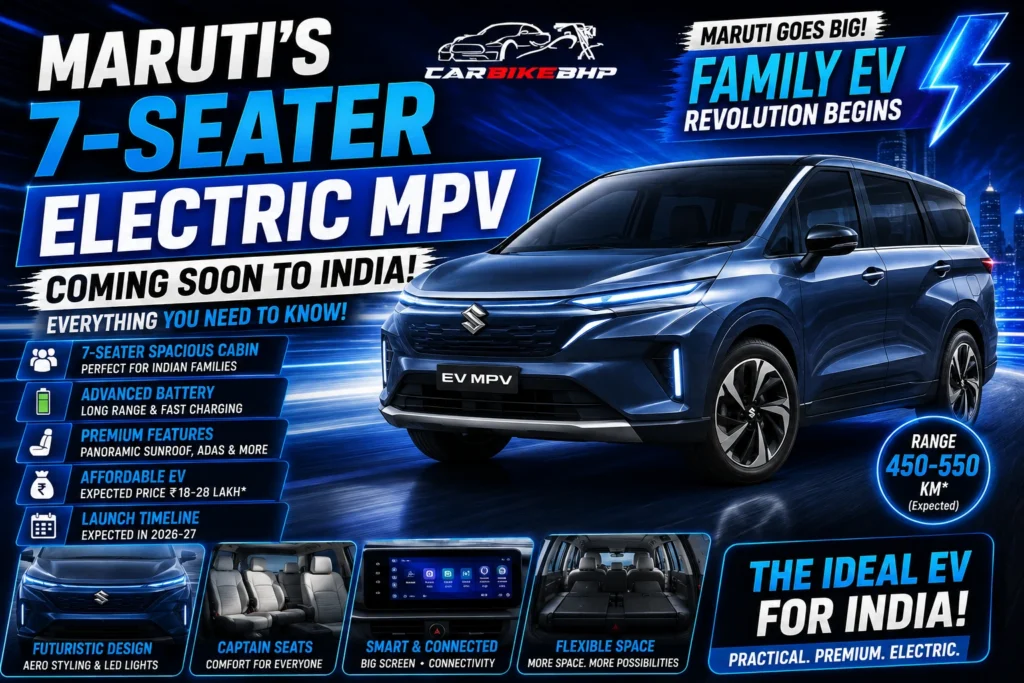
The upcoming Maruti 7-Seater Electric MPV could become one of the most important electric vehicle launches for Indian families over the next few years. According to emerging reports, Maruti Suzuki is evaluating a three-row electric MPV specifically for India, signalling the company’s intent to move beyond compact EVs and address the growing demand for practical family-focused electric mobility.
This development is significant because Maruti has traditionally dominated India’s family vehicle segment with products such as the Maruti Ertiga, Maruti XL6 and even the more premium Toyota Innova Hycross rival space through partnerships. However, until now, the company’s EV roadmap has largely revolved around SUVs and hatchback-like urban vehicles. The introduction of a Maruti 7-Seater Electric MPV suggests that the brand understands one important truth about the Indian market—large families still dominate buying decisions, and practicality remains more important than outright performance.
For Indian buyers in cities such as Delhi NCR, Bangalore, Pune, Hyderabad, Ahmedabad, and Chennai—where fuel expenses continue rising and charging infrastructure improves steadily—a spacious electric MPV could become an attractive alternative to diesel-powered family vehicles.
Why Maruti Suzuki Is Betting Big on an Electric MPV
The decision to reportedly explore a Maruti 7-Seater Electric MPV is not surprising when you look at how the Indian automotive market is evolving. SUVs may dominate headlines, but MPVs continue to quietly deliver strong volumes because Indian families value cabin space, seating flexibility, luggage room, and lower ownership costs.
Why an Electric MPV Makes Sense
| Market Trend | Impact |
|---|---|
| Fuel prices rising | EV ownership becomes attractive |
| Large family demand | 7-seater practicality matters |
| Urban commuting | EV running costs stay low |
| Government incentives | EV adoption improves |
For Maruti, this also represents an opportunity to dominate a segment where competition is still extremely limited. While electric SUVs have become crowded, there are very few mainstream three-row electric family vehicles currently positioned for mass-market buyers.
Unlike niche premium EVs priced above ₹30 lakh, a Maruti-branded electric MPV could appeal strongly to middle-class families looking for lower running costs without sacrificing passenger space.
This strategy aligns perfectly with Maruti’s long-standing philosophy—build practical products for the Indian middle class.
Also read – Maruti Brezza Facelift Spied Testing in India
What Platform Could the Maruti 7-Seater Electric MPV Use?
Reports suggest the Maruti 7-Seater Electric MPV may be based on a dedicated EV platform or a modified architecture shared with future global Suzuki EV products.
Expected Platform Details
| Component | Expected Details |
|---|---|
| Architecture | Dedicated EV platform |
| Layout | Front-wheel drive |
| Seating | 7-seater |
| Battery Position | Floor-mounted |
| Design Focus | Space optimization |
One major advantage of EV architecture is packaging flexibility. Unlike petrol or diesel MPVs, electric vehicles do not require large engine bays or transmission tunnels. This allows manufacturers to maximize cabin space while improving legroom and practicality.
For Indian families frequently travelling between cities or carrying luggage during weddings, holidays, or weekend road trips, this additional space becomes extremely valuable.
Maruti has historically prioritized efficiency and practicality over flashy engineering. Therefore, the Maruti 7-Seater Electric MPV will likely focus on usable family comfort rather than performance-focused specifications.
Also read – Maruti Suzuki April Sales India Hits Record 2.39 Lakh Units
Expected Design – More MPV Than SUV
The Maruti 7-Seater Electric MPV is expected to prioritize space and practicality over aggressive SUV styling. That said, Indian buyers increasingly prefer SUV-inspired visual cues, so expect a crossover-like design language rather than a boxy van-like appearance.
Expected Design Highlights
| Exterior Feature | Expected |
|---|---|
| LED Lighting | Yes |
| Connected Tail Lamps | Likely |
| Aero Alloy Wheels | Expected |
| Large Glass Area | Yes |
| Sliding Rear Doors | Possible |
Maruti understands that Indian families want premium-looking vehicles even when shopping for practical transportation. This is why the Ertiga and XL6 evolved visually over the years instead of remaining purely utilitarian products.
For buyers upgrading from products like the Ertiga or even compact SUVs, the new EV MPV will likely need to feel aspirational rather than functional.
Expect a cleaner, futuristic look with strong aerodynamic efficiency to improve driving range.
Also read – Maruti Grand Vitara Facelift Launching Soon in India
Battery, Range & Performance Expectations
One of the most important factors determining the success of the Maruti 7-Seater Electric MPV will be battery range.
Indian buyers still experience “range anxiety,” especially families who frequently travel long distances.
Expected Battery & Range
| Specification | Expected Value |
|---|---|
| Battery Size | 50–65 kWh |
| Claimed Range | 450–550 km |
| Real-World Range | 350–420 km |
| Charging | Fast Charging Expected |
| Drive Layout | FWD |
A real-world range above 350 km would be essential because Indian families often undertake intercity journeys. For example:
- Delhi → Jaipur
- Bangalore → Mysore
- Mumbai → Pune
- Hyderabad → Vijayawada
Maruti will likely tune the vehicle for efficiency rather than outright acceleration.
Expected Performance
| Metric | Expected |
|---|---|
| Power Output | 140–180 PS |
| Torque | 250–300 Nm |
| Top Speed | 140 km/h |
| Focus | Smooth family driving |
The emphasis will likely remain on relaxed commuting and comfort.
Interior Space Could Become the Biggest USP
The biggest advantage of the Maruti 7-Seater Electric MPV could be interior practicality.
Expected Interior Features
| Feature | Availability Expected |
|---|---|
| Panoramic Sunroof | Possible |
| Rear AC Vents | Yes |
| Captain Seats | Likely |
| Wireless Connectivity | Expected |
| Large Touchscreen | Yes |
| ADAS | Possible |
Indian buyers increasingly use MPVs as premium family vehicles rather than taxi-oriented products. That means comfort, cabin quality, and premium technology now matter more than ever.
The absence of a traditional transmission tunnel may improve second-row comfort significantly.
Also read – Maruti Y43 Micro SUV: Ignis Replacement Confirmed for India – What Buyers Should Expect
Expected Price of Maruti 7-Seater Electric MPV
Pricing will decide whether the Maruti 7-Seater Electric MPV succeeds or struggles.
Expected Ex-Showroom Price
| Variant | Expected Price |
|---|---|
| Base Variant | ₹18 lakh |
| Mid Variant | ₹22 lakh |
| Top Variant | ₹28 lakh |
Expected On-Road Price
| City | Top Variant |
|---|---|
| Delhi | ₹30 lakh |
| Mumbai | ₹31 lakh |
| Bangalore | ₹32 lakh |
Maruti will likely try to undercut premium EV rivals while offering stronger practicality.
Rivals of Maruti 7-Seater Electric MPV
Competition will include:
| Vehicle | Segment |
|---|---|
| BYD eMAX 7 | Electric MPV |
| Kia Carens EV | Upcoming EV |
| Toyota Innova Hycross | Hybrid MPV |
Where Maruti Could Win
- Lower running costs
- Wider service network
- Better resale confidence
- Strong family-focused positioning
What This Means for Indian Buyers
The Maruti 7-Seater Electric MPV could fundamentally change how Indian families think about EVs.
Until now, electric vehicles have mostly targeted:
- Urban commuters
- Young professionals
- Premium buyers
But Maruti appears ready to target family buyers, which is where the real mass-market opportunity exists.
Also read – Maruti Baleno Facelift 2026: New Design, Features & 5 Key Changes Spotted
Verdict
The upcoming Maruti 7-Seater Electric MPV could become one of the most strategically important launches for India’s EV market because it targets a category that remains surprisingly underserved—large families.
Rather than chasing flashy performance or luxury positioning, Maruti appears focused on practicality, affordability, and ownership convenience. If the company delivers strong range, competitive pricing, and familiar Maruti reliability, this electric MPV could emerge as India’s first true mass-market family EV.
For buyers currently considering diesel MPVs or hybrids, this is definitely a vehicle worth watching closely.